
Title: Engineer, industrialist, inventor, part-time clergyman, philanthropist
Birthdate: May 12, 1799
Death Date: January 27, 1892
Plot Location: Section 130, Lot 1
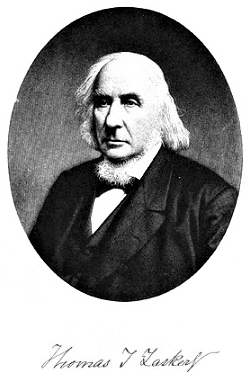
Thomas T. Tasker was born in Yorkshire, England of humble beginnings, but he developed mechanical skill, leadership ability, and a devout Christian character that earned great respect by the people of Philadelphia. His father, William, was a land surveyor, and was able to afford a better than ordinary English education. At the age of 13 he began a seven-year apprenticeship in the copper and ironsmith trades. He sailed for America in 1819 and settled in Philadelphia.
For a brief period he was employed in stove manufacturing. In 1820 he established a coppersmith and iron company in West Chester Pennsylvania. In 1824 he left that company and moved back to Philadelphia to work for Steven P. Morris, a manufacturer of stoves and grates. Thomas was considered a genius in mechanical engineering and was soon put in charge of the mechanical department. He moved up in the business to become a partner and owner. The company grew rapidly, expanding into the manufacture of tubes for gas, water, steam locomotives, and boilers.
Thomas married Elizabeth Hickman on February 24, 1829. They had nine children, six of whom survived. The Taskers lived for most of the late 1800s at 1502 South 5th Street
The company’s name changed several times between 1836 and the end of the 19th century as the Tasker and Morris families supplied sons and brothers to the ownership as the elders retired. The original S.P. Morris & Co. would become Morris, Tasker & Morris, then Pascal Iron Works, then Morris, Tasker & Co, & finally Delaware Iron Works. 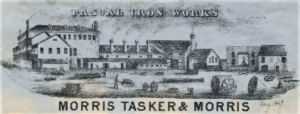 In 1858 Thomas retired and the head of the company was eventually left to one of his sons, Stephen Tasker. In 1872 there were two plants in Philadelphia; one at 3rd and Walnut Street, the other at 5th and Tasker.
The demand for their products grew and business greatly increased in size, employing over 2,000 men. It became necessary for better efficiency to connect the two plants which were approximately 1.5 miles apart. They petitioned the city of Philadelphia to allow a rail line to be laid to make the connection, but the city rejected the idea.
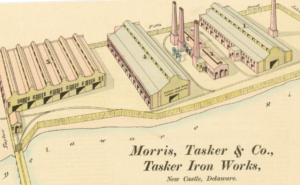 The company then looked elsewhere to build a new plant and settled on New Castle, Delaware. The factory was built on 35 acres directly on the Delaware River bounded by Fifth, Taylor and Johnson Streets. The company continued to grow until 1899 when it was merged into a much larger company called National Tube. In 1901 US Steel bought National and 9 other companies and manufacturing was consolidated in McKeesport, PA.
This incorporation marked history’s first billion dollar company with authorized capital of $1.4 billion. In 1904 they began dismantling and removing all equipment in New Castle, creating a public park called the New Castle Battery Park. The only structures that remain are about 100 row houses built for the workers and families in a complex called Dobbinsville.
Following his retirement in 1858, Thomas purchased 400 acres in various locations in Ridley Township, just southwest of Philadelphia. As a hobby he raised breeds of cattle, beginning with Durham cattle, then Ayrshires and Guernseys.
When the Civil War started in 1861 Thomas was one of its most enthusiastic supporters. He was one of the founders and president of the Citizens Volunteer Hospital located at Broad and Washington in Philadelphia. Under his administration it was operated in a broad and humane basis, treating both Union and Confederate soldiers equally. It treated over 200,000 soldiers. The entire expense was covered by voluntary contributions, mostly from Philadelphians. When the war ended in 1865 and the hospital closed, the remaining funds ($4,000) were given to the Soldiers’ Orphan Asylum in D.C.
When Lincoln was assassinated in April,1865 the funeral train route (called the Lincoln Special) was organized to symbolically retrace Lincoln’s journey from Springfield, IL to Washington, DC with stops along the way. Following the viewing in the Capitol, the train’s third stop was in Philadelphia where Thomas had the honor of being a pall bearer.
Thomas was a Methodist clergyman, skilled in preaching on an as-needed basis. He was instrumental in donating money and land for the establishment of new churches, donating the land on which Kedron Methodist was built in 1860. He helped start the Wharton Street Methodist Episcopal Church in his Southwark neighborhood in 1841, serving and worshipping there for 50 years, even serving as interim pastor in 1872. In 1863 he gave financial support to build the New Castle Methodist Episcopal Church which remains to this day at 510 Delaware Street.
Thomas had an inventive mind as well, receiving a patent in 1842 for a water hydrant and another in 1866 for a self-regulating hot water apparatus for private dwellings, schools, and offices. He founded the Gas Works in New Castle which manufactured gas and delivered it for cooking, heating and lighting through underground pipes manufactured by his company. He also founded the Water Works in New Castle, and shortly after 1868 he built a flour mill which he sold in 1872 to William Lea & Sons.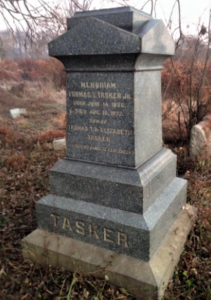
He died in 1892 and is interred with his wife, who died in 1877, along with nine other members of the family. Section 130 is known as the Wharton Street Methodist Episcopal Church plot. South Philly’s Franklin Street was renamed Tasker Street in his honor, and the subway station at 1600 South Broad Street commemorates the famous partners because Tasker Street is to the north and Morris Street is to the south.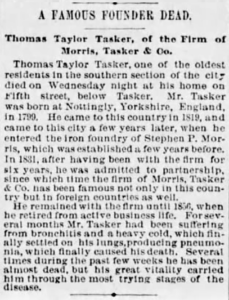
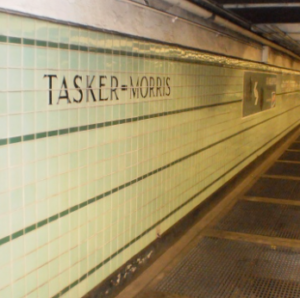
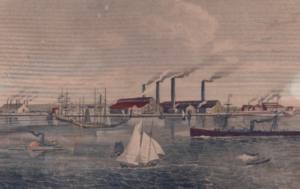
photo courtesy New Castle Historical Society
Support the Friends of Mount Moriah
Help us in our mission to restore and maintain the beautiful Mount Moriah Cemetery by donating to our cause or volunteering at one of our clean-up events.